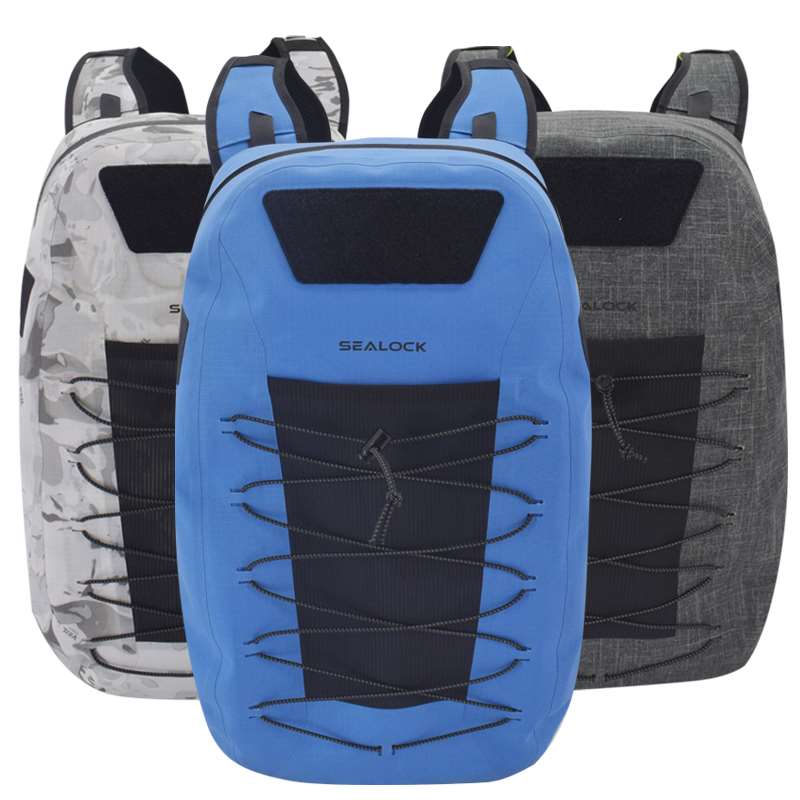
Sealock is a dry bag manufacturer and OEM supplier. Every factory says its bags are tested. The question that separates suppliers is a narrower one: tested how, on which units, and can you see the record? A dry bag is a single welded chamber with no lining to hide a weak seam, so testing is both easier to do honestly and easier to fake convincingly. This guide sets out the full inspection sequence a dry bag order passes through — from incoming rolls to the container door — and the questions a buyer should ask at each stage.
Agree the Test Method Before Production, Not After
This is the step buyers skip and then regret. Not every dry bag should be sold as submersible: some are built for rain, splash and wet decks, others for genuine immersion, and the difference is a specification decision rather than a marketing one. The test method has to be defined before bulk production begins, because it determines the weld width, the closure, and the fabric — you cannot test a bag into being submersible after it is built.
Fix these in writing before the run starts:
Material and denier, finished dimensions and tolerance.
Weld width, closure type, and the water-resistance standard in numbers — up to a verified IPX7 on sealed builds.
Hardware grade and colour standard, with a signed gold sample as the reference.
Which test applies, on how many units, and what evidence you receive.
Stage One — IQC: Stopping a Bad Roll Before It Reaches the Welder
Final inspection alone catches problems too late to fix cheaply. Incoming control is where the cheapest corrections happen:
Fabric — coating thickness, adhesion, and weldability checked against the signed standard. A batch variation changes how the material welds, so a roll that drifts out of spec produces marginal seams across an entire run.
Colour — colour difference and fastness against the signed colour card, which matters most when one colourway runs across ten sizes.
Hardware — buckles, webbing, D-rings and zippers checked for grade, dimension and function.
Stage Two — IPQC: Testing While the Line Runs
In-process control is what keeps unit five thousand identical to the approved sample:
Peel tests on sample welds at run start — the single most important in-line check. A weld is pulled apart to confirm the bond is fused rather than merely pressed. This is how a cold weld — a seam that looks finished and delaminates weeks later — is caught before it multiplies across a batch.
Cutting tolerance — a welded seam has no seam allowance to absorb drift, so panel accuracy is checked continuously.
Weld width and corner integrity — corners and direction changes are where heat and pressure are hardest to hold consistent.
Load-point assembly — strap anchors, D-ring patches and haul handles, stitched at high tension before sealing.
Closure function and logo application — roll-top alignment, stiffener bar binding, buckle operation, print registration.
Stage Three — OQC and the Leak Tests
Finished goods are sampled under ISO 2859 AQL procedures — random sampling that establishes whether the lot meets the agreed quality level without opening every carton — and compared against the signed gold sample. Alongside that, dry bags get physical leak testing. The common methods, and what each actually proves:
Test
What it proves
Real water-submersion (batch)
The sealed bag keeps water out under immersion — the headline claim
Air-inflation bubble test
Pinpoints where a leak is — escaping bubbles mark the seam or closure
Vacuum extraction + 24-hour hold
Finds slow, microscopic leaks a short dunk cannot reveal
Closure test
The roll-top folds and seals correctly at full load
Weld bond and peel strength
The seam is fused at molecular level, not surface-bonded
Load and jerk testing
Strap anchors and buckles hold under sustained and shock loading
Abrasion, tear, tensile
The bag survives rock, deck and gravel contact
Salt spray and UV
Seawater and a season of sun don't degrade coating or colour
Colour fastness and difference
Units match each other and match your listing photography
The Test That Catches What Immersion Misses
Immersion testing has a blind spot, and it's worth understanding because it explains why bags that "passed" still fail customers. A defect can be small enough to survive thirty minutes underwater and still let moisture through over a long day on the water.
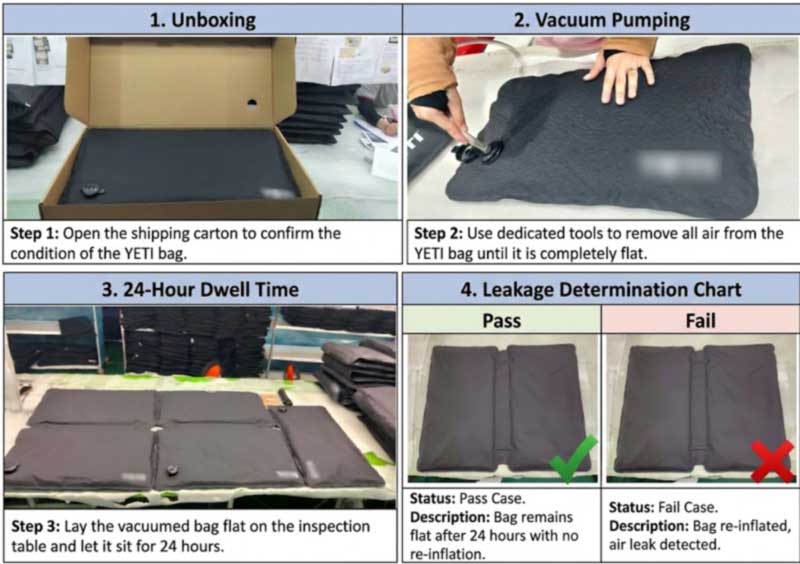
That is why Sealock strictly executes the complete customer inspection procedure on finished goods: unboxing, vacuum extraction, a 24-hour static rest, and air-leak determination. Drawing a vacuum puts the seal under a sustained pressure differential in the opposite direction, and twenty-four undisturbed hours give any leak path time to declare itself. A pinhole too small to admit visible water in a brief dunk will still bleed vacuum over a full day. On a single-chamber welded bag — where the whole product is the seal — this is the most revealing test available.
Draw a vacuum, wait a full day, judge the leak — negative pressure finds what water hides.
Stage Four — Pre-Shipment and Loading
A final pre-shipment inspection is conducted when production is complete and at least 80% of the order is packed, which is the point at which a sample genuinely represents the shipment. It covers workmanship, dimensions, function, packaging accuracy, carton marking and quantity. Third-party inspection through SGS or QIMA is available on request, and buyers are welcome to send their own inspector or attend themselves.
Container loading supervision is the last checkpoint — verifying that the right products and quantities are loaded, in the right condition. It's the stage buyers most often skip and the one that catches quantity and mislabelling errors before they become a claim.
What a Buyer Should Ask
Five questions separate a factory that tests from one that says it tests:
“Are these tests run on production samples or on production units?” — a critical distinction. A perfect pre-production sample proves the design; testing on units drawn from the actual run proves the batch.
“Can I see inspection photographs and records?” — evidence rather than assurance.
“Which welding method is used, and how is seam consistency checked?” — the answer should include peel testing at run start.
“What is the AQL level, and at what packing percentage is the final inspection run?”
“Can the approved sample be locked into a specification sheet with tolerances?” — a signed gold sample plus written tolerances is what makes any of the above enforceable.
Three sourcing mistakes follow from not asking: comparing suppliers on unit price without checking material thickness, approving weld appearance without testing seam strength or water resistance, and ignoring roll-top height and flexibility until the bulk goods arrive. Related construction detail is covered in our custom dry bag production guide.
The Product Basis
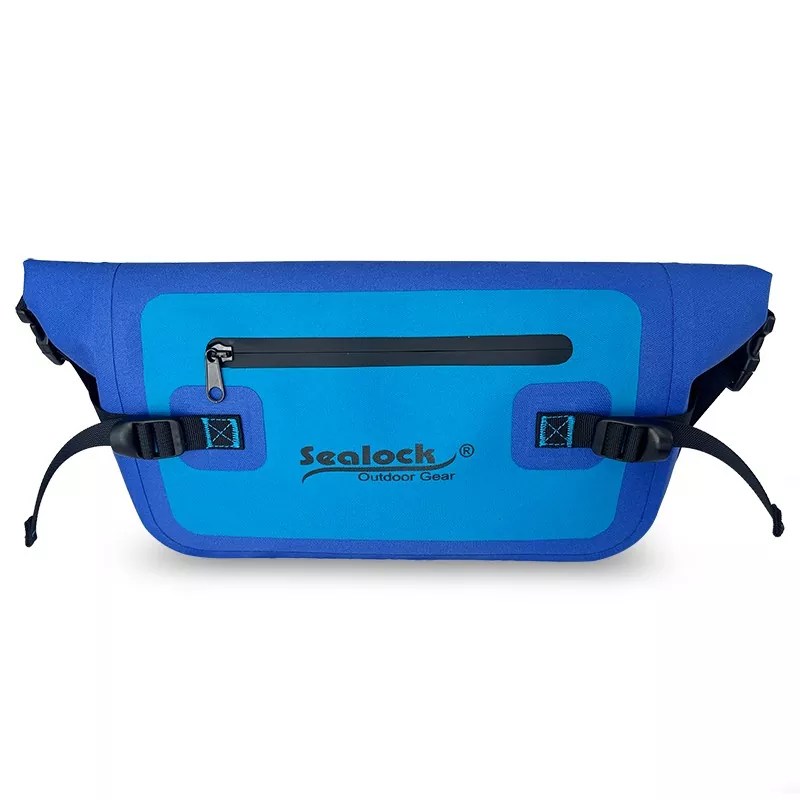
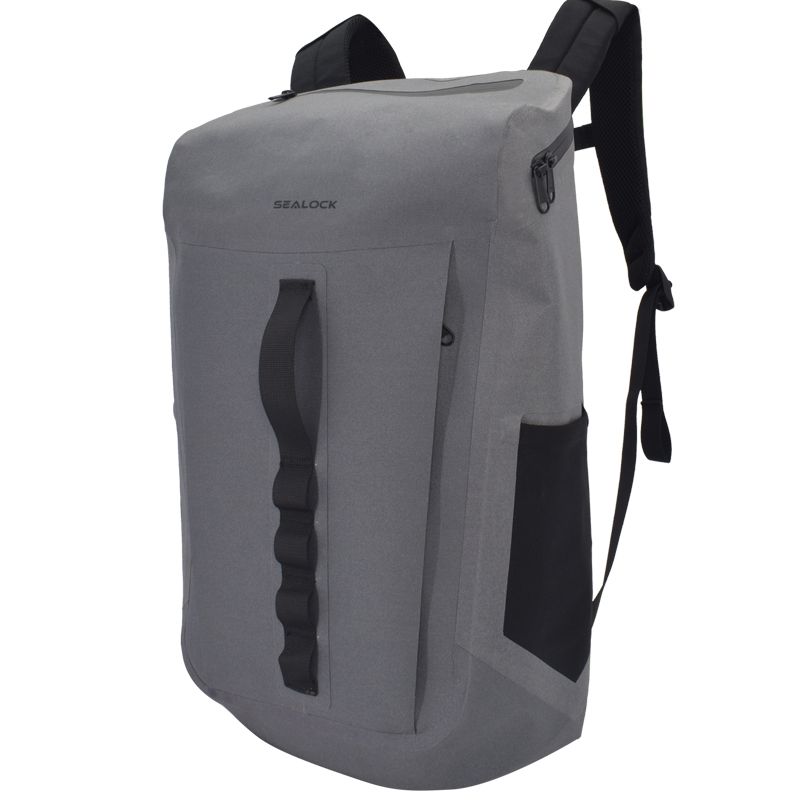
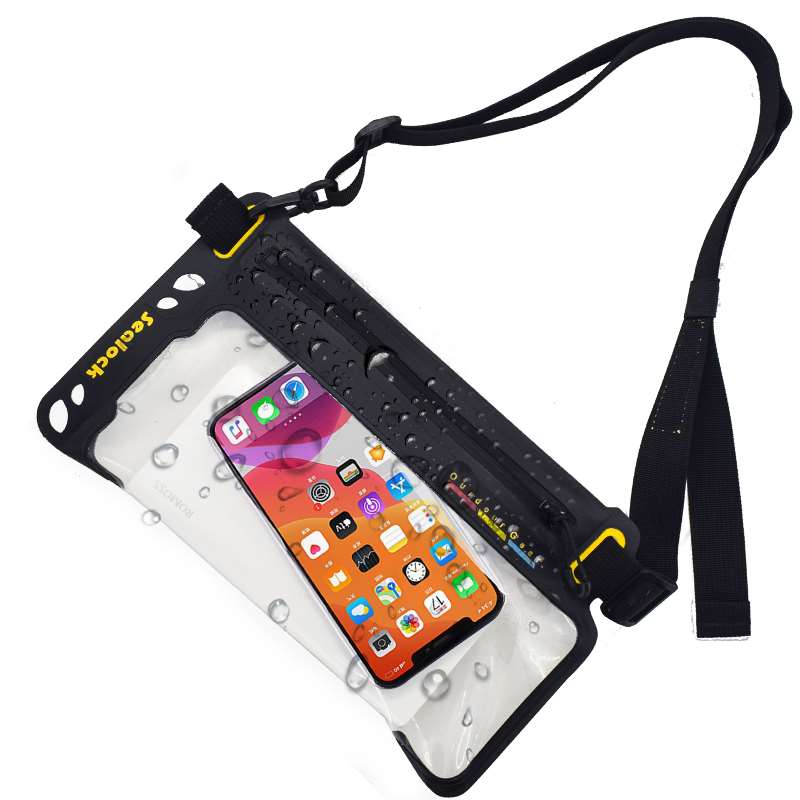
These welded bags, from Sealock's dry bag line, all pass the regime above and serve as equal starting points for an OEM order — none is ranked above another:
Image
Model & specs
Verification notes
MOQ
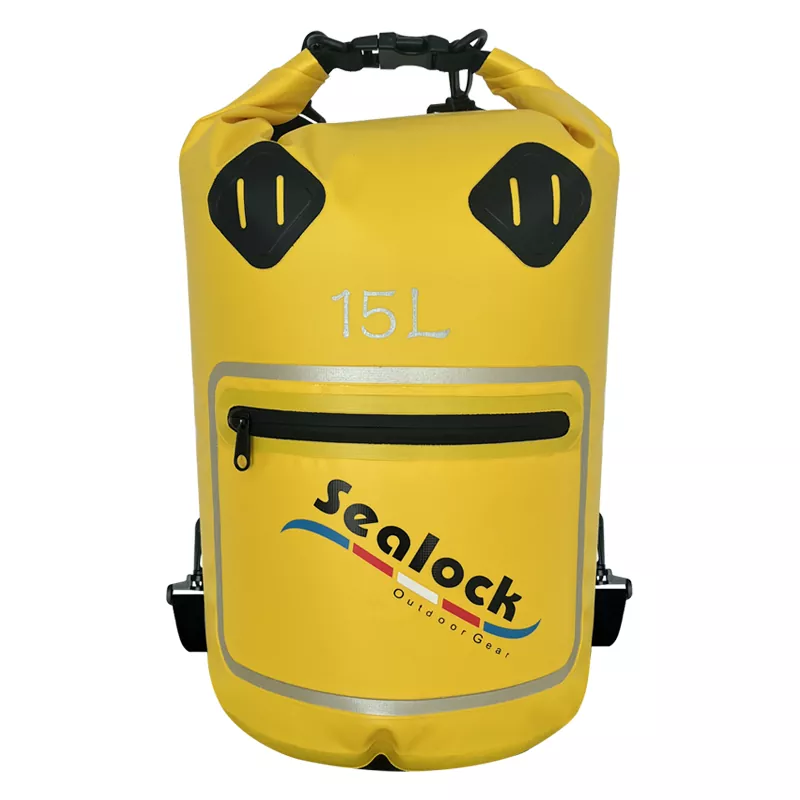
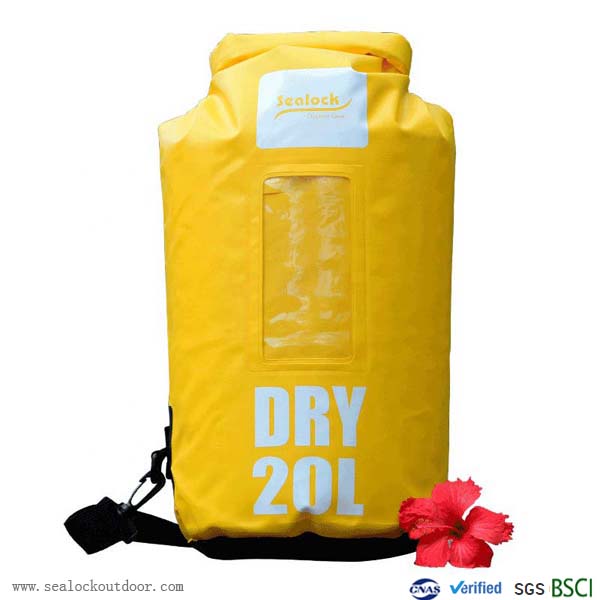
SL-D693 Tube Dry Bag with Window & Zip Pocket — 15L (53×36 cm) / 20L (57×38 cm); 500D PVC tarpaulin; transparent window; dry-wet separation; floats; detachable reinforced strap, POM buckle.
Rated and verified to IPX7 on the finished bag
300
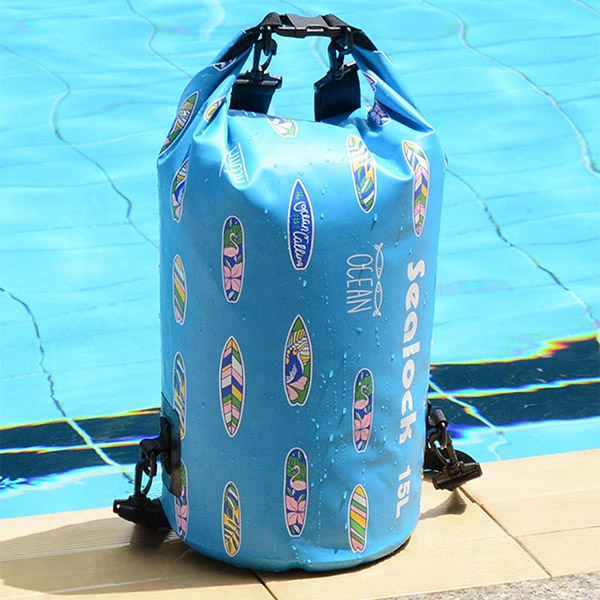
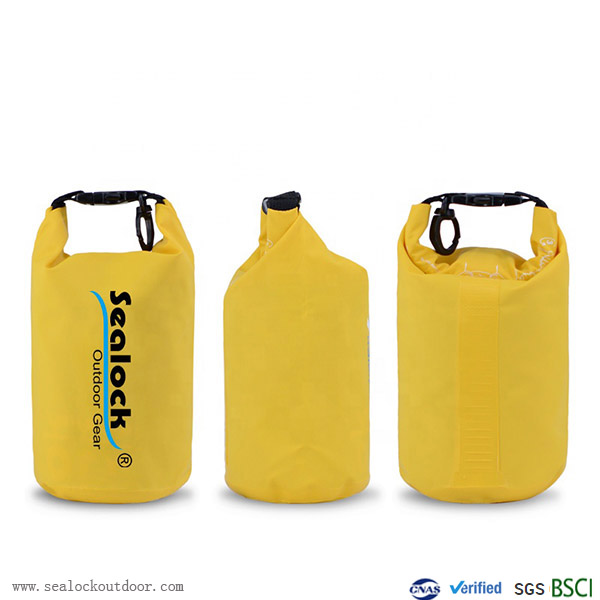
SL-D135 20L Roll-Top Dry Tube Bag — 500D PVC tarpaulin; seven colours; fold-seal with back-up Velcro; inner pocket with waterproof zipper.
Factory audited to ISO9001 and BSCI; Bureau Veritas certified
Factory-level compliance is auditable rather than asserted — ISO9001, BSCI, SMETA P4, HIGG, GRS and SCAN — with product-level Bureau Veritas, SGS, REACH, EN71 and RoHS testing on relevant models.
The One-Minute Test You Can Run on Arrival
Worth doing on every new sample and on units drawn from an incoming shipment:
Bubble test — roll the bag closed with air trapped inside, buckle it, and push it under water. Escaping bubbles mark the exact leak path, usually a seam or the closure.
Tissue test — put absorbent paper inside, seal it, submerge it fully for thirty minutes, then open and inspect. Dry paper is a pass.
Load the closure — fill the bag to about 80%, roll three to four times, and confirm the buckle closes without forcing. A bag that can't be folded properly at working load will be reported as leaking.
Pull the anchors — hang the loaded bag by its strap and give it a sharp tug.
FAQ: Dry Bag Testing and Inspection
Q: Are your tests run on samples or on production units?
A: Both, and the distinction matters. Peel tests run on sample welds at the start of each production run, and OQC draws AQL samples from the finished lot — so the evidence covers the batch you're buying, not only a pre-production sample.
Q: When is the final inspection carried out?
A: When production is complete and at least 80% of the order is packed, which is the point at which a sample is representative of the shipment. Container loading supervision follows.
Q: Can we get inspection records and third-party verification?
A: Yes — inspection photographs and records are available, SGS or QIMA pre-shipment inspection can be arranged, and you're welcome to send your own inspector.
Q: How do you catch a leak that immersion testing misses?
A: With vacuum extraction and a 24-hour hold. A pinhole that passes a brief dunk still loses vacuum over a full day, so negative-pressure testing finds the marginal seals immersion lets through.
Q: Should every dry bag be sold as submersible?
A: No, and this is worth being honest about in your listings. Some builds are for rain, splash and wet decks; others are for genuine immersion. Define the standard before production, because the test method drives the weld, closure and fabric specification.
Q: What makes any of this enforceable?
A: A written specification with tolerances plus a signed gold sample. Without those, an inspection has nothing objective to measure against.
Talk to the Factory
For test procedures, inspection records, and OEM/ODM proposals on dry bags, contact Sealock at info@sealock.com.hk or +86-769-82009361. Over twenty years of high-frequency welding, three-stage IQC/IPQC/OQC, third-party inspection on request, and a full customer inspection procedure on every shipment.
Ние използваме бисквитки, за да ви предложим по-добро сърфиране, да анализираме трафика на сайта и да персонализираме съдържанието. Използвайки този сайт, вие се съгласявате с използването на бисквитки от наша страна.
Политика за поверителност
 English
  Español
  Português
  русский
  Français
  日本語
日本語  Deutsch
  tiếng Việt
  Italiano
  Nederlands
  ภาษาไทย
  Polski
  Svenska
  magyar
  Malay
Malay  বাংলা ভাষার
  Dansk
Dansk  Suomi
Suomi  हिन्दी
  Pilipino
  한국어
한국어  Türkçe
  Gaeilge
  العربية
  Indonesia
  Norsk
Norsk  تمل
تمل  český
český  ελληνικά
  український
  Javanese
  فارسی
فارسی  தமிழ்
தமிழ்  తెలుగు
  नेपाली
  Burmese
  български
  ລາວ
ລາວ  Latine
  Қазақша
  Euskal
  Azərbaycan
  Slovenský jazyk
  Македонски
  Lietuvos
  Eesti Keel
  Română
  Slovenski
  मराठी
मराठी  Srpski језик